
Can I practice yoga with a herniated disc?
I get asked all the time if it’s possible to practice yoga with back pain or a herniated disc. Most people are curious about the physical side of yoga, and my answer is: it depends. For those who see yoga as more than just the physical practice, my answer is yes! Yoga offers so much more than asanas on the mat, and my own journey has reminded me just how true that is.
Starting my full-time yoga path with this injury felt like a setback. In my previous blog post I’ve shared how it is to hold space with a herniated disc. But before being a teacher, I am a practitioner first. My self-practice has always been my foundation, and this injury has deeply impacted how I show up on and off the mat. In this post, I want to focus on my journey as a yoga student; how my practice has evolved and the lessons I’ve learned through this healing process. Because yes, being a yoga student with a herniated disc has offered me deeper insights into the essence of yoga itself.
I am a visual learner and so, here’s a peek into my experience within one table. It is broken down into phases. Each one marks a significant shift in how I approached my practice and my healing (Did I mention I used to be a digital project manager? I guess I’m still a fan of thinking in phases! 😂). I like to reflect from a holistic bird's-eye view and I’m sharing my journey here for illustration purposes.
High-level timeline of my journey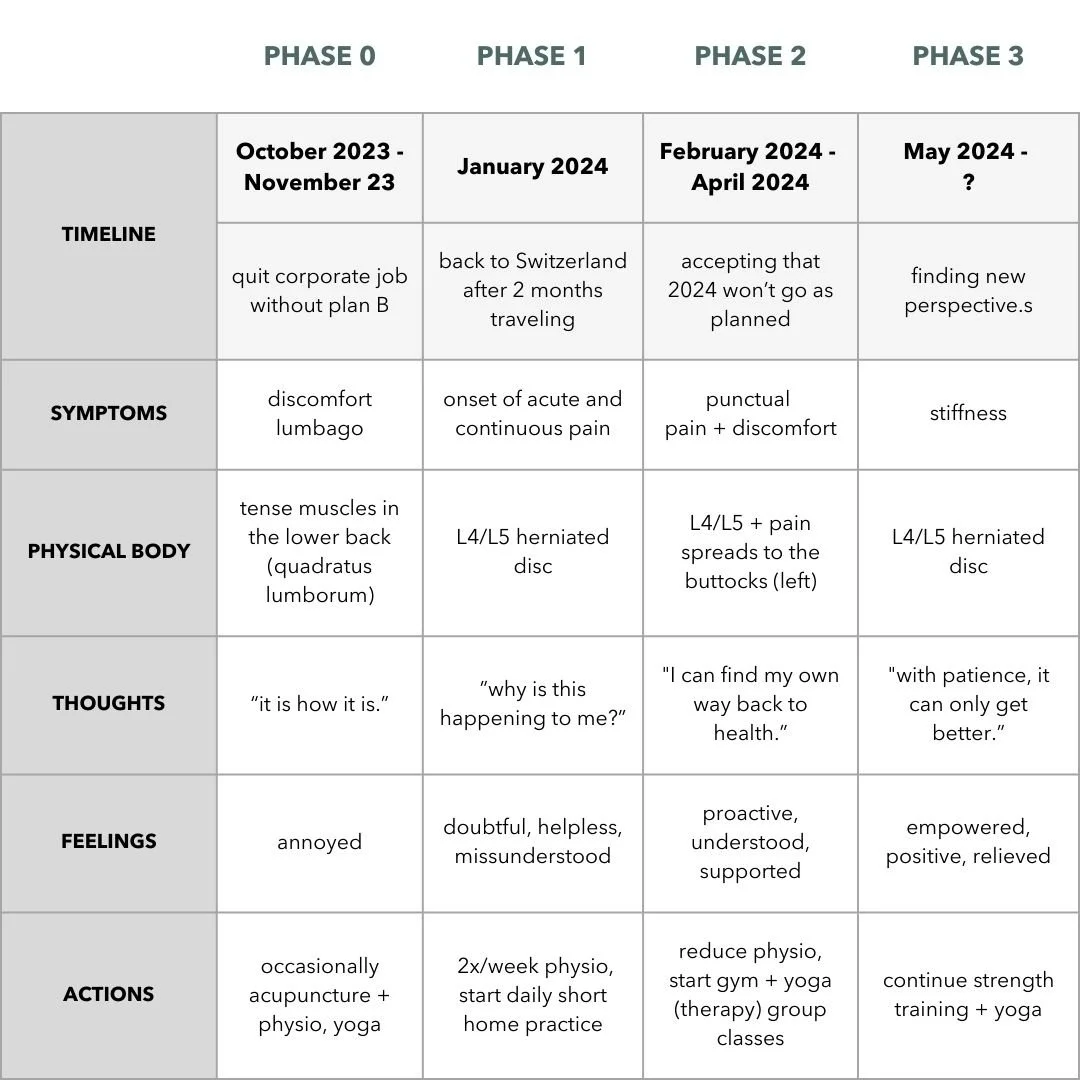
Disclaimer: Keep in mind that each healing journey is personal and unique.
Phase 0: Discomfort and change
It is hard to say when something starts. I remember my first lower back pain showed up 10 years ago, when I was training for the New York City Marathon. Is that the starting point of this journey or Winter 2020, when after spending a day skiing I couldn’t stand up anymore? It’s hard to say but it all contributed for sure. Yet, here I decided to take as a starting point October 2023, because it was marked by a significant transition, both in terms of my physical health and my professional life. Indeed, I just quit my corporate job without another one lined up. Which used to be the case. And in that moment, I was grappling with discomfort and lumbago. Which was unfortunate since I signed up for various yoga teacher trainings. In that moment, without knowing, I was already practicing satya (honesty of body). Yes, I pursued my physical practice of yin and vinyasa yoga, but also kept in mind that there is so much my physical body can do at the moment.
Phase 1: Acute pain and adaptation
Returning to Switzerland after two months of travel, I encountered a new level of acute and continuous pain. I had two long flights back from New Zealand to Switzerland and I could feel that physically, something was off. As soon as I landed, one of the most intense period of suffering I’ve ever experienced started. I couldn’t sleep, I couldn’t sit, I couldn’t walk… I couldn’t think clearly. I didn’t know what to do. Or what was happening to me. I had no choice but to preserve my own energy (brahmacharya). I reduced my social interactions and focused on what I could, and what I needed to do. I couldn’t attend any long yoga classes, knowing I couldn’t sit or bend forward more than 2 millimeters. Still, I practiced yoga at home. Daily. Incorporating short warm-ups and mobility-centered asanas. The focus shifted from intense practice to gentle movements designed to ease the pain and improve flexibility. Nothing fancy. Nothing “complicated”. Gentle cat-cows or supported child’s poses. That’s where I practiced discipline (tapah). I showed up even when I didn’t want to. Even when it seemed there was no difference. Or progress whatsoever.
Phase 2: Acceptance and evolving practice
After a month of suffering, the pain became more punctual, and I started seeing improvements. With reduced reliance on physiotherapy, I began exploring Yoga Therapy and incorporated short sequences into my daily practice. This step empowered me to attend again yoga classes. Why? because instead of seeing my body as non-cooperative and yes, an enemy, I saw it as a partner with which I had to communicate. Mainly listen to. Yoga therapy helped me with that. I listened and realised that I can practice poses, what was hurtful to me where the short and faster transitions (ahimsa). So I decided to turn to hatha yoga. This phase involved embracing the limitations of my body while integrating new techniques and therapies into my practice. The goal was not just to recover physically but to adapt my expectations and approach to yoga. I started to accept that the year wouldn’t unfold as I had planned. And as I did, I started to feel a physical change and I started to celebrate and be content of every new milestone (santosha). Being able to perform a warrior pose without any pain? Woooow, you should have seen me smiling throughout the whole practice that day!
Phase 3: New perspectives and continued growth
In this final (?) phase, I found a new perspective on my practice. While constant pain had diminished, I continued to experience stiffness in my back, hamstrings, and hip flexors. My practice evolved to include a mix of Hatha, yin, and “slow” vinyasa yoga classes. This phase is characterized by a deeper understanding of how to work with my body’s current state and a continued commitment to my practice. I still get sensations back from time to time and that’s how I know I am still in my recovery phase. Which seems sometimes hard to understand for the outside world. Yes I can perform a headstand. No, I can’t carry heavy things or vacuum (#iykyk). Does it make sense? Maybe not, yet I am trying to learn, understand, introspect and just like writing this post, I think it’s important to share and talk about it (svadhyaya).
How did I practice yoga (focus on sadhana pada)?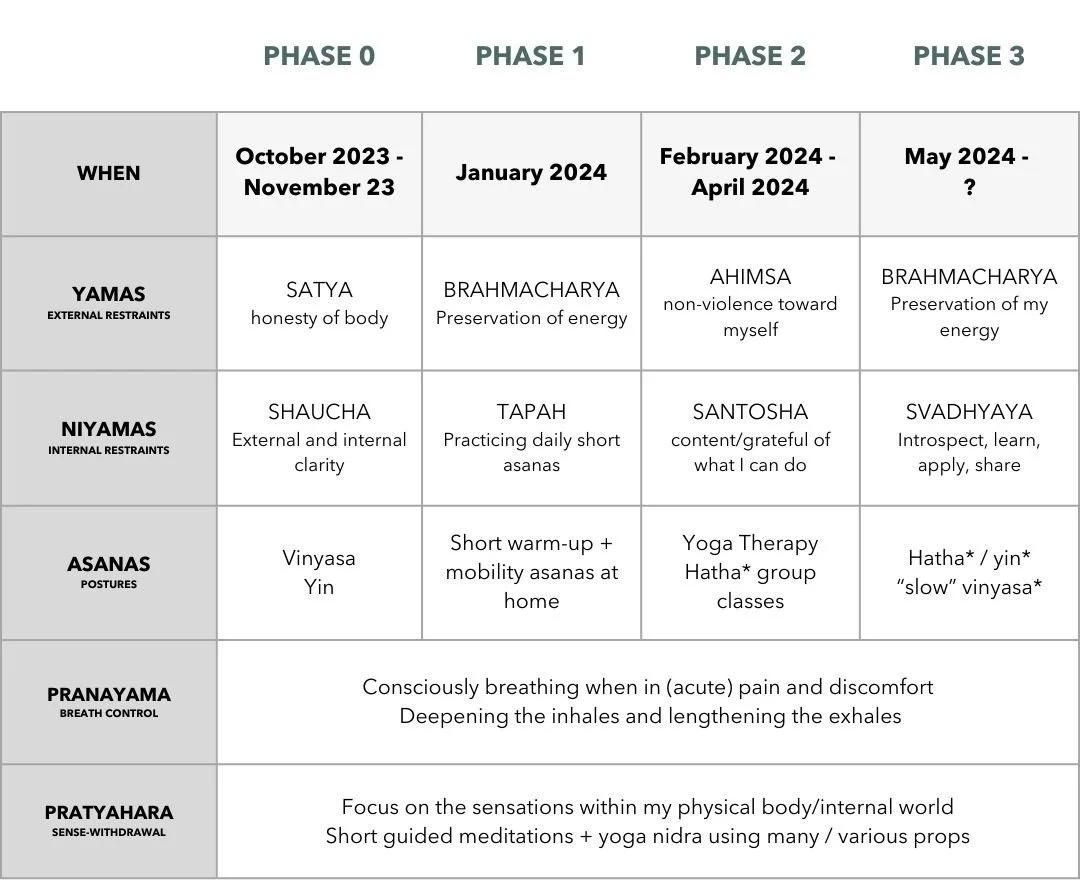
And now?
The toughest for me is to accept that I can’t predict how long it will last and when I will be able to practice asanas without thinking about my back… I feel though that I have walked the 80% of my recovery and that I have to accept that the remaining 20% might take thrice so long. What I know is that throughout these phases, yoga has been more than just “physical exercise”. It has been a journey of acceptance, adaptation and growth. It’s not easy but hey, it’s part of the journey.
Let’s figure it out together!
If you’re dealing with back pain or any other challenge, remember that yoga’s true essence lies in its ability to support you holistically. Embrace the journey, learn from it and find solace in the practice. Not just as a physical “workout” but as a path to greater understanding of yourself. And your practice.
Have you wished you’d have someone to talk it through? Someone who could help you come back to your practice and show you how to adapt your sun salutations for example? I’d love to help. I’m offering 1:1 private sessions.